Skip to content

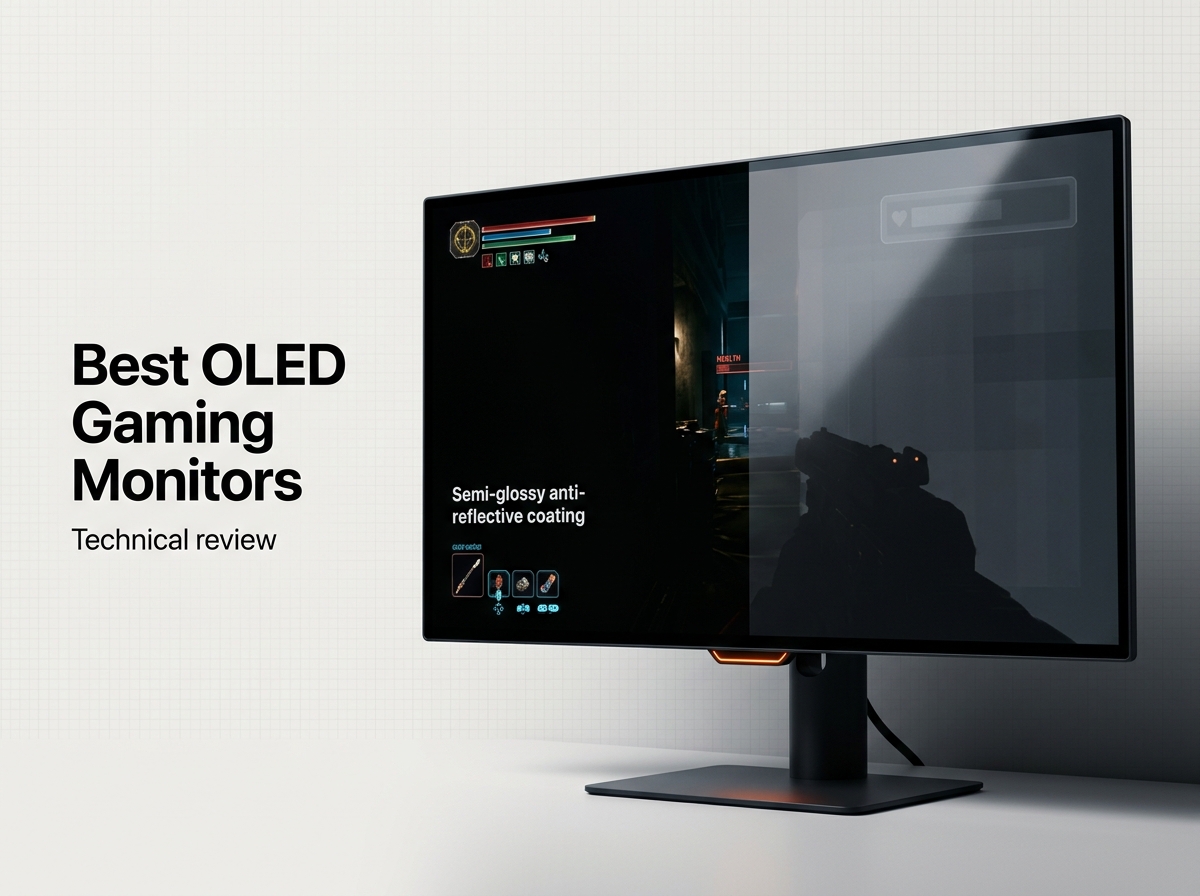
Best OLED Gaming Monitors

Marcus Chen Marcus Chen 7 min read

Choosing Your Next OLED Gaming Monitor

Buying an OLED gaming monitor in 2026 isn't about pretty colors anymore—it's about choosing the right trade-offs. Peak motion clarity at high refresh rates, real HDR behavior, modern connectivity for consoles and PCs, and a plan for OLED's long-term risks all matter. This shortlist is a critical, purchase-focused ranking based on published specifications from ASUS ROG, Dell, MSI, and LG, plus independent reporting from RTINGS.com, TechSpot, and Tom's Hardware.

At a glance for September 2026: the best overall is the ASUS ROG Swift OLED PG32UCDM; the most cinematic curved pick is the Dell Alienware AW3225QF; the value-focused alternative in the same class is the MSI MPG 321URX QD-OLED; the high refresh rate OLED monitor for competitive players is the ASUS ROG Swift OLED PG27AQDP; and the immersion-first ultrawide is the LG 34GS95QE-B.

Key takeaways: 4K at 240Hz is the current sweet spot for premium OLED gaming. Curved QD-OLED can look spectacular, but it's not everyone's productivity-friendly shape. USB‑C power and KVM features matter more than most spec sheets admit. Burn-in risk isn't gone—warranty terms and OLED care features still matter. If you mainly play esports titles, 1440p at 480Hz can be the smarter spend.

This guide ranks monitors by comparing published specs, independent measurements from RTINGS.com, and editorial assessments from TechSpot and Tom's Hardware. We evaluate motion performance, HDR tone-mapping, connectivity, burn-in mitigation features, and warranty coverage—not through in-house testing, but by synthesizing the most credible public information available.


Reviewed by Marcus Chen Updated How we rate

At a Glance

  • Best Overall ASUS ROG Swift OLED PG32UCDM Cleanest all-around 4K 240Hz QD-OLED without forced curve; USB‑C with 90W power delivery.
  • Best Curved 4K Dell Alienware AW3225QF Enveloping curved QD-OLED with Dolby Vision and 3-year burn-in warranty for HDR video.
  • Best Value 4K MSI MPG 321URX QD-OLED Same core 4K 240Hz QD-OLED experience with strong connectivity at a more value-oriented position.
  • Best High Refresh ASUS ROG Swift OLED PG27AQDP 480Hz at 1440p for competitive motion clarity; easier to drive than 4K for esports titles.

Key Takeaways

  • 4K at 240Hz is the current sweet spot for premium OLED gaming in 2026.
  • Curved QD-OLED delivers spectacular immersion but trades productivity-friendly flatness.
  • USB‑C power delivery and KVM switches matter more than most spec sheets reveal.
  • Burn-in risk persists; warranty terms and OLED care features remain critical.
  • For esports players, 1440p at 480Hz can be the smarter spend than 4K.

How These Monitors Were Evaluated

This guide ranks OLED gaming monitors by comparing published specifications from ASUS ROG, Dell, MSI, and LG with independent reporting from RTINGS.com, TechSpot, and Tom's Hardware. We evaluate motion performance based on stated refresh rates and pixel response times, HDR capabilities from VESA DisplayHDR certifications and tone-mapping features, connectivity including USB‑C power delivery and KVM support, and burn-in mitigation through warranty coverage and manufacturer care features. No in-house lab measurements or hands-on testing inform these rankings—this is a desk research synthesis of the most credible public information available. The criteria prioritize what actually affects daily gaming: responsiveness for competitive play, HDR quality for cinematic content, desk ergonomics for multi-device setups, and long-term risk management for OLED panels. Motion performance separates on refresh rate ceilings—240Hz for the 4K models, 480Hz for the competitive 1440p pick. HDR diverges on feature sets: Dell's Dolby Vision versus VESA DisplayHDR True Black certification elsewhere. Connectivity proves the sleeper differentiator—USB‑C with high-wattage power delivery and KVM switches change daily usability more than spec sheets admit. The honest downsides matter as much as the highlights: burn-in and image retention remain real risks with static HUDs, OLED brightness management can be visible in certain content, and VRR flicker can still appear depending on panel and game behavior. OLED wins on contrast, but it punishes careless static content.

Read full reviews

Best OLED Gaming Monitors Ranked

The top five OLED gaming monitors in September 2026, ranked by editorial assessment of published specs and independent reporting.

ASUS ROG Swift OLED PG32UCDM

ASUS ROG Swift OLED PG32UCDM

Best Overall

The cleanest all-around pick for 4K OLED without forced curve. 31.5-inch QD-OLED with 240Hz, VESA DisplayHDR True Black 400, USB‑C with 90W power delivery, and practical extras for mixed gaming and productivity use.

9.2/10
Editorial score
  • Flat panel suits productivity
  • USB‑C 90W power delivery
  • HDMI 2.1 and DisplayPort 1.4 with DSC
  • 99% DCI-P3 coverage
  • Relies on Display Stream Compression over DP 1.4
  • OLED care routines required
  • bright rooms expose OLED limitations
Dell Alienware AW3225QF

Dell Alienware AW3225QF

Best Curved 4K

Most cinematic curved 4K for HDR video. 31.6-inch curved QD-OLED with 240Hz, Dolby Vision support, VESA DisplayHDR True Black 400, and 3-year limited OLED burn-in hardware warranty from Dell.

9.0/10
Editorial score
  • 1700R curve for immersion
  • Dolby Vision support
  • 3-year burn-in warranty
  • HDMI 2.1 FRL for console 4K 120Hz VRR
  • Curve is a strong preference choice for mixed use
  • USB-C functions as hub not display input
  • no KVM switch
MSI MPG 321URX QD-OLED

MSI MPG 321URX QD-OLED

Best Value 4K

Value-focused 32-inch 4K 240Hz alternative.

8.7/10
Editorial score
  • Two HDMI 2.1 ports capable of 4K 240Hz
  • USB‑C with DP Alt Mode and 90W PD
  • AMD FreeSync Premium Pro and G-Sync Compatible
  • 250 nits typical SDR brightness
  • feature set reads less premium than top models
  • less polish overall
ASUS ROG Swift OLED PG27AQDP

ASUS ROG Swift OLED PG27AQDP

Best High Refresh

Best high-refresh competitive pick for esports. 26.5-inch QHD WOLED with native 480Hz refresh, VESA DisplayHDR 400 True Black, and OLED Care+ features for motion clarity in competitive shooters and arena titles.

8.9/10
Editorial score
  • Native 480Hz at 1440p easier to drive than 4K 240Hz
  • 0.03ms pixel response
  • OLED Care+ burn-in mitigation features
  • 1440p not as crisp as 4K for text-heavy work
  • 480Hz only worth it if PC sustains the frame rates
LG 34GS95QE-B

LG 34GS95QE-B

Best Ultrawide

Best ultrawide immersion without ultra-large format.

8.5/10
Editorial score
  • 800R curve for wraparound immersion
  • NVIDIA G-SYNC and AMD FreeSync Premium Pro
  • DisplayHDR True Black 400
  • 1.5M:1 contrast ratio
  • WQHD ultrawide not a 4K replacement in sharpness
  • aggressive curve less ideal for straight-line design or layout work
OLED gaming monitors comparison lineup showing flat and curved models
OLED gaming monitors compared side by side in September 2026

Motion Performance and Refresh Rates

Motion performance is where OLED's near-instant pixel response reputation comes from, but refresh rate still dictates the ceiling. The 4K models above top out at 240Hz—the ASUS ROG PG32UCDM, Dell AW3225QF, and MSI MPG 321URX all share this specification. For competitive players who prioritize motion clarity above all else, the ASUS ROG PG27AQDP is the specialist option at 480Hz, though it trades down to 1440p resolution.

That 480Hz ceiling matters because it's meaningfully easier to drive at 1440p than 240Hz is at 4K. If your PC can sustain the frame rates that make that refresh rate worth it, the PG27AQDP raises the bar for competitive shooters and arena titles. If not, you're paying for speed your system can't deliver.

HDR and tone-mapping are where features diverge most. Dell leans into Dolby Vision on the AW3225QF, a concrete differentiator for cinematic content and console HDR. The others typically anchor HDR claims around VESA DisplayHDR True Black certification in their spec sheets—400 nits for most models, which OLED can sustain in small highlights without the full-screen brightness penalties LCD faces.

Connectivity and desk ergonomics are the sleeper differentiators. USB‑C with high-wattage power delivery—90W on the ASUS PG32UCDM and MSI MPG 321URX—and a KVM switch can meaningfully change daily usability. RTINGS.com highlights that distinction when comparing 32-inch 4K 240Hz QD-OLED models, and TechSpot calls out the absence of a KVM on the Dell AW3225QF as a practical knock for multi-system setups.

The AW3225QF's USB-C port functions as a hub rather than a display input, which limits flexibility. If you're switching between a gaming PC and a work laptop daily, that missing KVM matters more than another 50 nits of peak brightness. Modern connectivity isn't just about pixel delivery—it's about how the monitor fits into a real desk workflow.

OLED Gaming Monitors: Pros and Cons

Advantages

  • Near-instant pixel response delivers true motion clarity for fast-paced gaming.
  • True HDR with per-pixel dimming and 1.5M:1 contrast ratios for cinematic depth.
  • Premium models offer USB‑C power delivery and KVM switches for clean desk setups.
  • 4K at 240Hz hits the sweet spot for premium gaming in 2026.
  • Curved QD-OLED options deliver spectacular immersion for single-player and HDR video.

Trade-offs

  • Burn-in and image retention remain real risks with static HUDs and desktop UI.
  • OLED brightness management can be visible in certain content and bright rooms.
  • VRR flicker can still appear depending on panel and game behavior.
  • Curved panels trade productivity-friendly flatness for immersion in games and video.

What OLED Still Gets Wrong

What OLED Still Gets Wrong

The Honest Downsides

Burn-in and image retention remain real risks with static HUDs and desktop UI, so monitor-side care features and warranty language matter as much as refresh rate. OLED's brightness management can be visible in certain content, and room lighting plus coating choice can change perceived contrast. VRR flicker can still appear in edge cases depending on the panel and game behavior—RTINGS. com explicitly discusses differences in that behavior between competing QD-OLED models.

Verdict

If you want one premium recommendation that balances everything—speed, sharpness, ports, and day-to-day usability—the ASUS ROG Swift OLED PG32UCDM remains the best overall buy in September 2026. Choose the Dell Alienware AW3225QF if you want the curved, Dolby Vision-focused wow factor and you value the clearly stated burn-in warranty support. Choose the MSI MPG 321URX QD-OLED if you want the same core 4K 240Hz experience with strong connectivity at a more value-oriented position.

View All Monitors

Explore More Reviews

Ready to Compare More OLED Options?

Browse our full collection of gaming monitor reviews, buying guides, and calibration tutorials for every budget and use case.

Sources

  1. ASUS ROG — ROG Swift OLED PG32UCDM | Monitors | ROG USA
  2. ASUS — ASUS Republic of Gamers Announces Availability of ROG Swift OLED PG32UCDM Gaming Monitor | News|ASUS USA
  3. Dell — Alienware 32 4K QD-OLED Gaming Monitor - AW3225QF | Dell USA
  4. PR Newswire — Alienware Doubles QD-OLED Family with Two World's First Gaming Monitors
  5. TechSpot — Dell Alienware AW3225QF 32" Review
  6. MSI — MPG 321URX QD-OLED Specification